No products in the cart.: AED 0.00

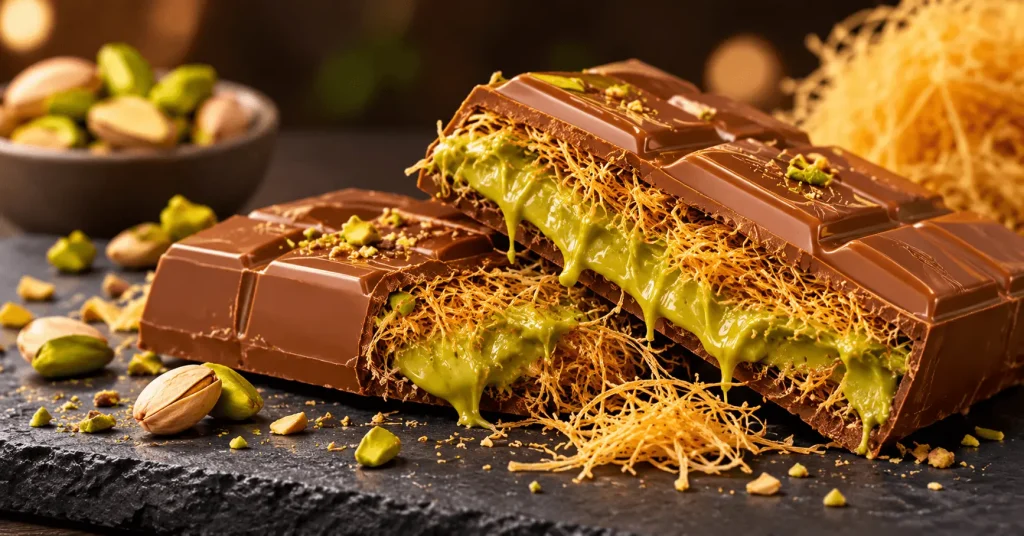
Dubai chocolate is a chocolate bar with a crunch inside. That’s the whole product, and it somehow ended up in lawsuits, supermarket rationing and a global nut price spike.
Here’s the plain version: what it is, where it came from and what to check before you part with £16. I pulled this from court coverage, trade reporting and the Wikipedia entry, and I flag where the sources disagree.
Dubai chocolate is milk chocolate wrapped around a pistachio-tahini cream studded with chopped kataifi (also spelled kadayif), the shredded pastry from knafeh. The flavour is borrowed from knafeh, the Middle Eastern dessert of crisp pastry, cheese and syrup. Break one open and you get green cream and a snap of golden strands.
Fix Dessert Chocolatier, an online chocolatier in Dubai, makes the original. Everything else, from supermarket versions to pizza, is a copy or a spin-off.
The bar started in 2021, according to Wikipedia’s account. Fix co-founder Sarah Hamouda, a British-Egyptian engineer living in Dubai, says the idea came from pregnancy cravings. She worked on the recipe with Filipino pastry chef Nouel Catis, who suggested a bar built around knafeh. It was first released in 2022 as “Can’t Get Knafeh of It”, with a yellow and green wrapper.
Early bars were handmade. Wikipedia reports a team working six to eight hours could make about 25 a day, and each bar sold for roughly £16 at first.
Then TikTok. Fast Company puts the tipping point in 2023, when food reviewer Maria Vehera posted a video of herself eating the bar that passed 124 million views. Fix had a small marketing budget and leaned on influencers filming themselves cracking it open. Wikipedia credits the bright green interior with much of its appeal.
By 2024 the trend was huge, and in September 2024 Fix made an exclusive flavour for Dubai’s Crown Prince, Sheikh Hamdan bin Mohammed Al Maktoum, after he endorsed the bar.
Sources differ on small details, like who developed the recipe and which year counts as “the launch”. Both Wikipedia and Khaleej Times agree on the core fact: Fix in Dubai made it first.
Three parts, and the contrast is what sells it.
The idea travelled fast. Copies went to supermarkets, and the flavour moved into other foods: Dubai chocolate pizza, shakes (Shake Shack ran a version), and a “Dubai chewy cookie” that Wikipedia says went viral in South Korea in early 2026. A JoongAng Daily report cited there says the cookie craze has since faded.
This is where it gets messy.
The UAE hasn’t signed the Geneva Act of the Lisbon Agreement, which would protect geographical indications like place names. Most legal scholars cited on Wikipedia treat “Dubai chocolate” as a generic term in the EU market. That left the courts to argue about it.
Here’s the German timeline, from the sources I read:
→ January 2025, Cologne. A court ruled Aldi had to stop selling its “Alyan Dubai Handmade Chocolate”, made in Turkey, because the name could mislead shoppers into thinking it came from Dubai.
→ Later, Cologne again. A second chamber of the same court overturned that decision, according to a legal commentary by Andersen. It took what the author calls a “radically different stance”.
→ Frankfurt, Lidl case. The court found the name wasn’t misleading. Its reasoning: “Dubai” has become an adjective for a style, and shoppers expect a regional recipe, not a product made in Dubai.
The Andersen article doesn’t give dates for the later rulings, so I can’t tell you which came when. What it does say is that rulings so far have favoured the confectioners using the name.
Nouel Catis told Khaleej Times in January 2025 that using “Dubai chocolate” for a bar not made in Dubai is misleading, and that makers could say “Dubai-style” instead.
My read: treat “Dubai chocolate” on a label as a style, and “made in the UAE” as a fact. They are not the same claim.
A bar made of pistachio cream needs a lot of pistachios. Fast Company reported in April 2025, citing a Financial Times interview with nut trader Giles Hacking, that kernel prices rose from $7.65 to $10.30 a pound in a year. His line: “The pistachio world is basically tapped out at the moment.” A poor US harvest the year before had already tightened supply.
Iran supplies roughly a fifth of the world’s pistachios, per New Lines Magazine. Iranian exports to the UAE jumped 40% in the six months to March 2025 compared with the whole prior year, according to the Iran Pistachio Association figure Fast Company cites. South Korea’s tax service said its 2025 pistachio imports had doubled versus 2020, and linked that to Dubai chocolate.
Then 2026. New Lines Magazine reported in May that exports from Iran to the Gulf were subdued because of the Strait of Hormuz disruption. It said importers saw wholesale prices go from about $22 a kilo to nearly $25 in recent weeks. That figure comes from unnamed importers, so read it as a rough signal, not official market data. The same piece says American pistachios are drier and less suited to confectionery, so makers can’t just swap suppliers.
Translation: the nut is the cost driver, and the nut is getting harder to ship.
If you want the original, buy from the maker, not a reseller. If you just want the flavour, a Dubai-style bar from a brand that lists its pistachio percentage and its factory country will do the job. Prefer pistachio and kunafa in a cake instead? Try our Kunafa Pistachio Cake, browse the cakes collection or read our guide to the top 10 cake flavours.
Either way, read the back of the wrapper before the front. The front is marketing. The back is the product.
Dubai chocolate is milk chocolate filled with pistachio-tahini cream and crunchy kataifi, a shredded pastry. It’s inspired by knafeh, the Middle Eastern dessert. The original comes from Fix Dessert Chocolatier in Dubai, first released in 2022 as “Can’t Get Knafeh of It”. Many other brands now sell versions under the “Dubai chocolate” name.
Fix Dessert Chocolatier, a Dubai-based online chocolatier, made the original bar. Its co-founder Sarah Hamouda came up with the idea in 2021, according to Wikipedia’s account, and she developed the recipe with Filipino pastry chef Nouel Catis. Accounts differ slightly on who did what, but both point to Fix as the origin.
There’s no single answer. A Cologne court first found in January 2025 that a Turkish-made bar called “Dubai chocolate” could mislead shoppers, but a later decision by another chamber of that court went the other way. A Frankfurt court also found the name wasn’t misleading. Check the label for the country of manufacture.
Pistachios are a big reason. A Financial Times report cited by Fast Company said kernel prices rose from $7.65 to $10.30 a pound in a year. The original bar was also handmade in small batches and first sold for about £16. Supply shocks, including disruption around the Strait of Hormuz in 2026, have added pressure.
“Dubai chocolate” has come to mean any bar with pistachio cream and kataifi, but the original is the Fix bar. “Dubai-style” signals a copy of the recipe, not a product made in Dubai. A chef involved with the original has said makers can use “Dubai-style” wording but shouldn’t use the viral product’s name.